
Interesting things to make out of paper—from mathematical models to toys.
Impossible Triangle
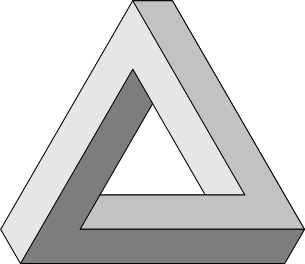
L.S. Penrose and his son Roger (after whom the Penrose tile is named) created the impossible triangle optical illusion. Obviously, you can't actually create an impossible triangle, but you can create a model that appears to be impossible if viewed from a specific angle.
Steps
- Download and print out the pattern from www.sandlotscience.com or from coolopticalillusions.com
- Follow the directions printed on the pattern.
Notes
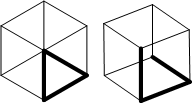 This illusion is based on the ambiguous drawing of a cube in an isometric projection. In this orientation the corner closest to the viewer and the corner farthest away coincide. This means that traveling down the closest edge of the cube, across the bottom two edges can appear to come back to the starting point when in fact it ends at the far corner.
 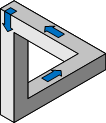 The impossible triangle is at the heart of M.C. Escher's "Waterfall" illusion.
- After studying this illusion, try building an analogous 3-D model of an impossible 4-D Quadrilateral
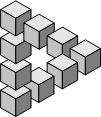 The Swedish artist Oscar Reutersvärd created impossible objects in his art. He created a version of the impossible triangle based on a series of cubes.
References

Comments
comments powered by Disqus